
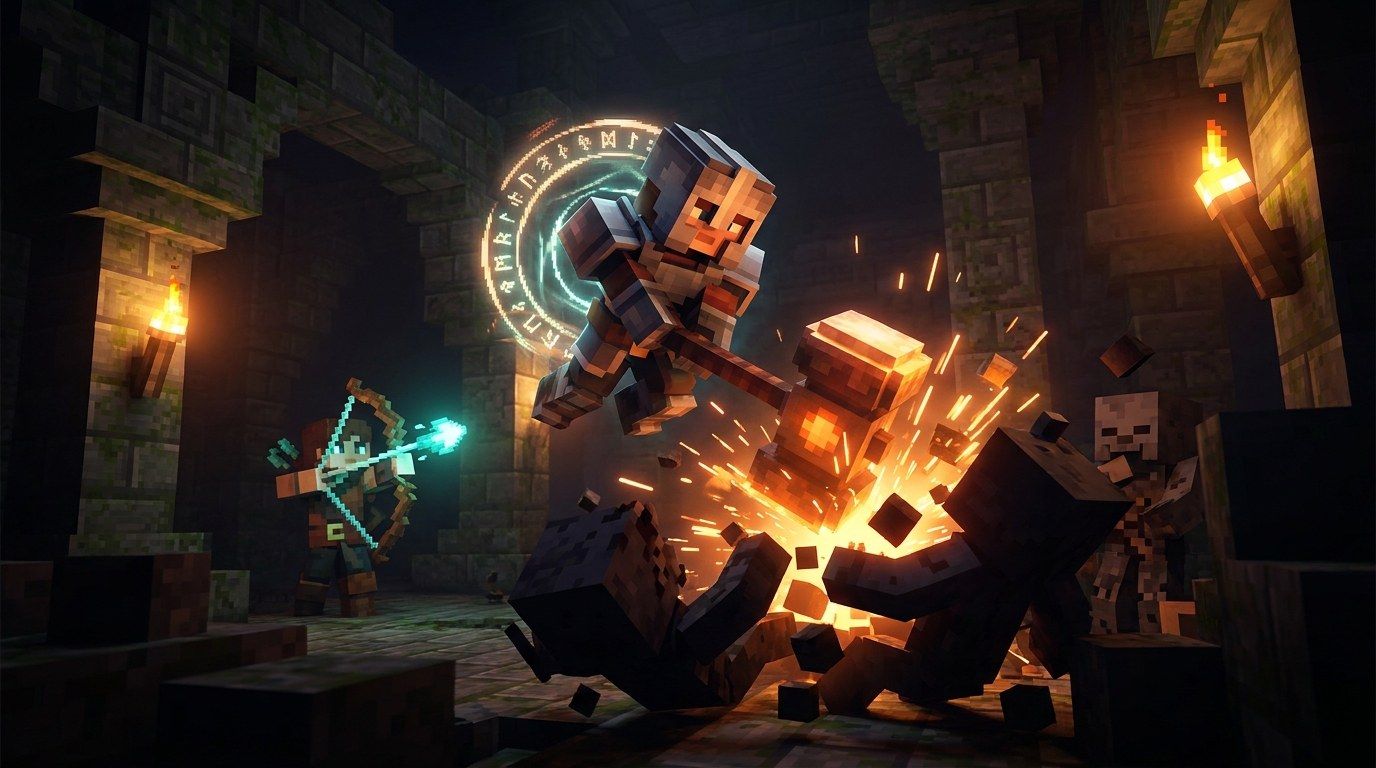
Minecraft Dungeons 2 gameplay keeps the original’s melee-and-ranged loop but adds real verticality: a jump ability with a per-weapon jump attack, four separate armor slots, and talismans that grow stronger the more you use them. Xbox’s showcase and gamescom demos gave the first real look at this loop ahead of the September 29 release of Minecraft Dungeons II.
What does the moment-to-moment gameplay loop feel like?
The loop is still fight through a space, loot gear, and push toward a boss, but jumping changes the rhythm. Minecraft.net describes a “contiguous, fixed and interconnected world, dotted with dungeons” instead of the original’s mission select screen.
That interconnected structure means you walk between encounters rather than loading into a new level each time. Mojang has been explicit that this is not an open world, just a more connected one, so don’t expect full open-world freedom.
How does combat work: melee, ranged and jump attacks?
Combat still splits between melee and ranged weapons, the same two-lane system from the first game, now layered with a new vertical option. Jumping lets you strike from above, and every weapon type gets its own unique jump attack.
Xbox Wire notes the jump mechanic “enhances combat tactility,” giving fights more spacing options than the largely flat arenas of the 2020 original. Enemies span slimes, skeletons, spiders and illagers, building up to set-piece boss fights.
What are artifacts and how are they different from talismans?
Artifacts are active, cooldown-based abilities you trigger in combat, while talismans are passive charms that level up the more you fight. They fill different roles: artifacts spend a resource for a burst effect, talismans quietly boost your build over time.
Artifacts cost Souls, the game’s mana equivalent, earned by defeating enemies, and go on cooldown after use. Talismans take up three dedicated slots and never expend a resource. Early hands-on coverage highlighted a bone talisman that summons a combat dog companion.
How does the four-piece armor system change builds?
Armor is no longer one item slot; it is now a helmet, chestplate, leggings and boots, each with its own enchantment sockets. That is a direct expansion from the single armor slot in the first Minecraft Dungeons.
Combined with melee or ranged weapons, three artifact slots and three talisman slots, the total build space is far larger than the original’s six-slot loadout. Minecraft.net’s systems article confirms combat slots roughly double as a result.
How does exploration and pacing compare to the first game?
Exploration is slower and more deliberate than the original’s dungeon-crawl pace, built around a fixed interconnected map instead of discrete missions. Hands-on previews describe collectibles and hidden talismans scattered through the world rather than only inside instanced levels.
Lighting plays a bigger role too. Xbox Wire describes “dappled sunlight through trees” giving way to dark, torch-lit caves, a visual cue for when the pacing shifts from open exploration into a tighter dungeon fight.
What does co-op actually feel like?
Co-op supports up to four players, mixing local split-screen, online with friends, or matchmaking with strangers in any combination. That flexibility is aimed at both casual groups and players who want to team up with strangers online.
The most common early complaint is losing track of your own hero once a fight gets crowded, especially during boss encounters like the Twisted Warden. Previewers describe it as a readability issue with screen clutter, separate from how co-op itself plays.
What gameplay changes stood out most in the reveal?
The gameplay reveal at June’s Xbox Games Showcase centered on three additions: jumping, the four-armor-slot system, and talismans. Those three systems came up in nearly every piece of early coverage that followed, more than any story or visual detail.
Boss design also got a visible upgrade. The Twisted Warden fight shown at the reveal is built around all four players coordinating together, rather than each player fighting independently, which is a shift from how the original handled its boss encounters.
A second boss, the Copper Monstrosity, appeared in later gamescom demos, suggesting Mojang is spacing out its set-piece encounters rather than front-loading them the way the first Minecraft Dungeons sometimes did.
Quick FAQ
What are the biggest gameplay changes from the first Minecraft Dungeons? A new jump ability with jump attacks, four armor slots instead of one, and talismans as a new passive gear type alongside active artifacts.
Is combat still melee and ranged only? Yes, those remain the two weapon categories, but jumping adds a vertical option and a jump attack unique to each weapon.
Do talismans replace artifacts? No. Artifacts are active, cooldown abilities that cost Souls; talismans are passive charms that level up with use. Builds use both.
Is the world actually open world? No. Mojang describes it as an interconnected world with dungeons, and is explicit that it is not calling it open world.
How many players can play co-op? Up to four, through local play, online with friends, or matchmaking, in any mix.
For how these early impressions compare to what players think of the finished build, see our early reviews roundup. Buyers deciding between platforms can also check PC system requirements or edition differences before launch.
Not confirmed yet
Full campaign length, final difficulty balance across the whole game, and how server performance holds up in live co-op sessions are all unconfirmed. These are based on hands-on demo segments, not a finished build, so treat pacing and difficulty impressions as provisional until launch.